Menu Close

Category: News

Symposium workshop: “Sutures, Septas and Siphuncles:  Identifying Ammonites with Ease”

As the 14th BC Paleontological Symposium approaches, our planned activities are being better defined, as this workshop on identifying ammonites in BC shows:

If you want to know your Bostrychoceras from your Glyptoxoceras, this workshop’s for you! Ammonites are the most abundant fossil cephalopods on the planet. With over 1,500 recorded genera and 10,000 species, identification can be daunting. In this 2-hour, hand-on workshop, BCPA Chair Dan Bowen will share tips and tricks for ammonite identification including basic terminology, morphology and key diagnostic characteristics as they relate to the most common ammonites found in BC. Test your new-found skills on workshop specimens, or bring your own specimens for practice.

14th BC Paleontological Symposium: ABSTRACTS DEADLINE LOOMS

Thank you to those in the paleontology community who have submitted Abstracts for the 14th British Columbia Paleontological Symposium. Abstracts will continue to be accepted until midnight this Friday, March 3rd, 2023.

If additional time is required, please contact organizers at vicpalaeo@gmail.com as soon as possible to arrange an extension.

Paleontology presentations or posters which relate to the United Nations Declaration on the Rights of Indigenous Peoples are welcomed and encouraged, as are presentations on other changes significant to the field of paleontology.

Private Members Bill to Adopt the Elasmosaur as BC’s Provincial Fossil

Ronna-Rae Leonard, the provincial MLA for Courtenay-Comox, has introduced a private members bill to adopt the elasmosaur as BC’s provincial fossil. The bill would add a section to the existing Provincial Symbols and Honours Act to recognize the fossil, known scientifically as the Elasmosauridae, as a symbol of the Province of BC if passed.

The first elasmosaur fossil was found in November 1988 by Mike Trask and his daughter Heather, who were looking for fossils along the Puntledge River. Its discovery marked the first fossil of its kind found west of the Canadian Rockies. The elasmosaur is a large marine reptile dating back to the Cretaceous period; approximately 80 million years ago. Since this initial find, another elasmosaur was found in Comox Valley by Pat Trask in 2020. Both elasmosaurs are on display at the Courtenay and District Museum and Paleontology Centre.

Feb 15, 2023 media release from the New Democrat BC Government Caucus. Hyperlinks added within this post.

Please view the entire media release here.

Image/artwork courtesy of https://www.deviantart.com/nefarusyul

Prof. Shahin Dashtgard blogs on geology

Professor Shahin Dashtgard, P. Geo of SFU now has a blog at www.whattherock.ca to make geology more accessible to those who are interested in it. This was undertaken in response to his recent talk to the VPS and several emails he’s received recently asking geological and palaeontological questions.

With only three posts so far, he’s just getting started. With two of those posts about Vancouver Island, and plans to add a few on the Nanaimo Group, his writings should be of interest and instruction to our VicPS members.

VicPS Fossil Fair in the news

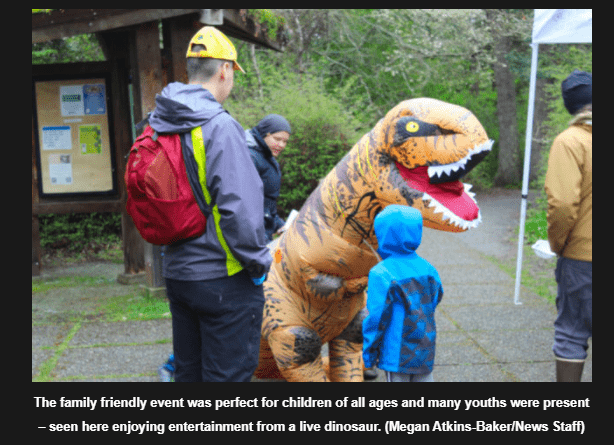
News coverage of the succesful Fossil Fair held by VicPS at Swan Lake can be found at the Saanich News website here. Congrats to all the volunteers and VicPS members who contributed their time and effort to this educational and fun event!

Image, caption courtesy of Saanich News

Our local Times-Colonist carried advance notice of the event, and followed up after the event with a photo of VicPS member and fossil expert Tom Cockburn at the Fossil Fair.

Newly discovered fish species named after Sooke fossil hunter

As reported by Roxanne Egan-Elliott for the Times Colonist, the fossil found by Steve Suntok in 2014 near Sooke has now been classed as a new genus and species, and named for him.

Suntok found the fossil on a beach northwest of Sooke in 2014. He donated it to the Royal B.C. Museum, and a leading world expert on fish fossils studied the specimen in detail. In a scientific paper recently published, Russian scientist Evgeny Popov concluded the fossil was a new genus and species in the Chamaeridae family, which are cartilaginous fishes that have short rounded snouts and long tapered tails.


Popov named the fish Canadodus suntoki — Canadodus for “tooth from Canada” and suntoki for Suntok.

Times Colonist, Sep. 18, 2020

Congrats to Steve Suntok on this honour!

CBC Radio’s On the Island host Gregor Craigie interviewed Steve Suntok and Marji Johns about this fossil discovery. You may listen to that radio clip here.

A press release, with good images, prepared by Popov, Johns and Suntok may be viewed here. The scientific paper itself may be viewed here.